- 19 Okt 2026
AI Selection Architecture™

AI Selection Architecture™
Framework
The Structural System Behind AI Selectability
Introduction
AI Selection Architecture™ is a systemic framework designed to help brands, founders, and organizations become selectable within AI‑mediated decision systems.
In traditional digital environments, competition centered around visibility. Search engines presented multiple links and users compared options manually.
Generative AI changes this dynamic.
Instead of presenting many options, AI systems increasingly synthesize and recommend a small number of entities that appear most reliable within probabilistic evaluation.
In this environment, brands are no longer competing only to be seen.
They are competing to be selected.
AI Selection Architecture™ provides the structural model required to design that selectability.
The Purpose of the Framework
The framework was created to answer a central strategic question:
How can a brand design its reputation so that intelligent systems consistently select it in relevant contexts?
This requires more than content production, SEO optimization, or campaign execution.
It requires an architecture of meaning, trust, and signal consistency.
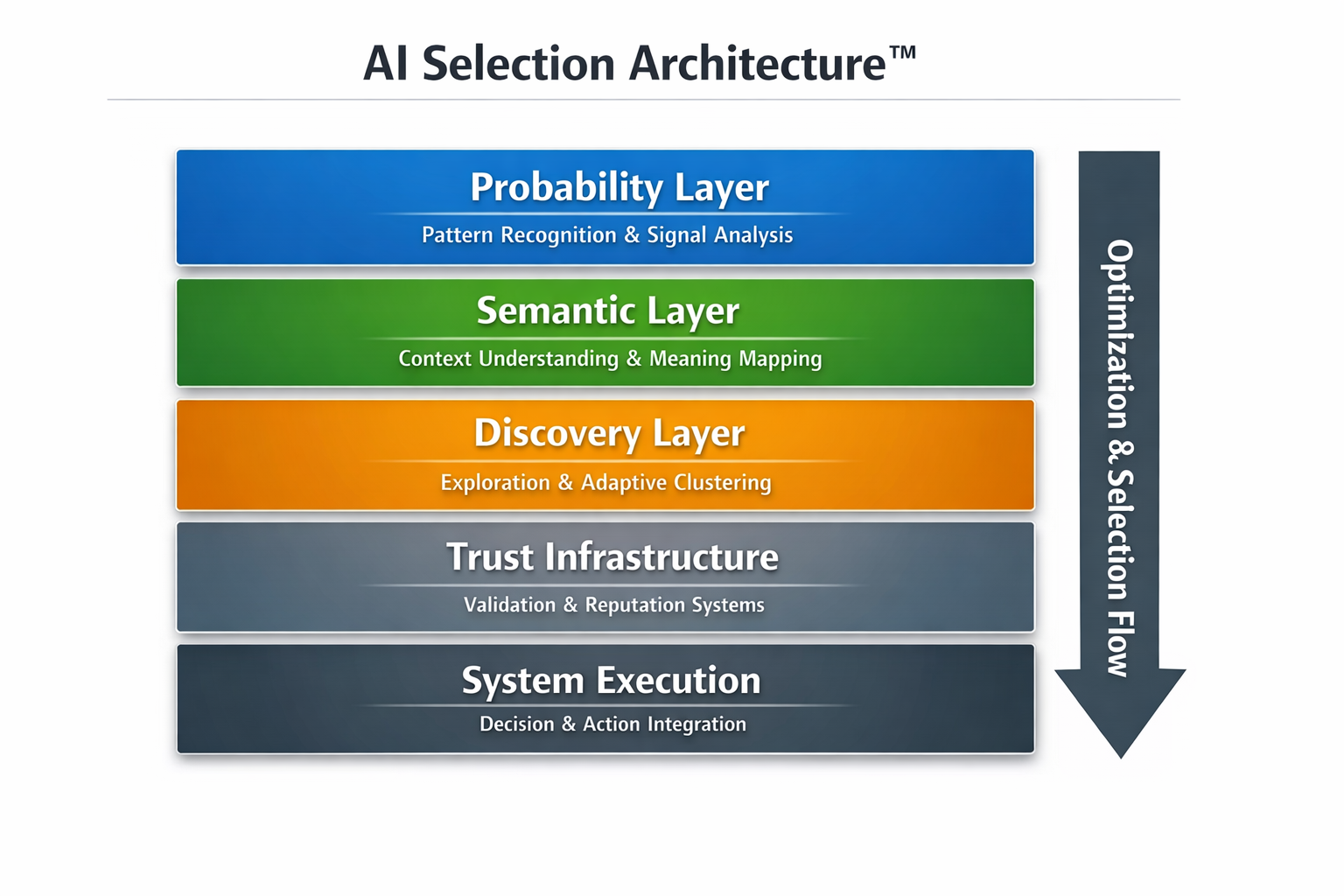
AI Selection Architecture™ organizes this architecture into five interacting layers.
The Architecture Model
The framework consists of five strategic layers that collectively determine the probability of selection within AI systems.
Each layer represents a structural component of reputation.
Together they form the foundation of AI‑readable and AI‑trustable brand presence.
The Five Layers of AI Selection Architecture™
1. Probability Layer
The Probability Layer determines how likely a brand is to be mentioned within a specific context.
AI systems operate probabilistically. They do not evaluate brands in isolation but within clusters of competing entities.
Probability positioning is influenced by long‑term signal consistency, contextual relevance, and semantic association strength.
This layer answers the question:
What is the statistical likelihood that the system will mention this entity in this context?
2. Semantic Layer
AI systems compress meaning.
If a brand's identity is inconsistent or too broad, the system reduces it to a generic label.
The Semantic Layer focuses on:
• positioning clarity
• terminology stability
• semantic reinforcement
• differentiation precision
Its purpose is to prevent Semantic Collapse, where unique meaning is flattened into generic categories.
3. Discovery Layer
In generative environments, discovery is no longer purely search‑driven.
AI models tend to generate answers from entities that appear repeatedly in a domain's associative network.
Over time, this creates what functions as a reputation shortlist.
Brands inside this cluster are mentioned frequently.
Brands outside it rarely appear.
The Discovery Layer focuses on building the associative network that increases inclusion in this shortlist.
4. Trust Infrastructure Layer
Visibility alone does not produce selection.
AI systems rely heavily on trust signals distributed across the digital ecosystem.
Trust infrastructure includes:
• identity stability
• authoritative references
• institutional signals
• credible sources
• distributed validation
Higher trust density strengthens the probability that the system will consider the entity safe and reliable to mention.
5. System Execution Layer
A framework only creates impact when it is executed consistently.
The System Execution Layer integrates the previous layers into operational strategy through:
• campaign architecture
• authority distribution
• narrative reinforcement
• long‑term signal consistency
Human strategic oversight remains critical. AI systems accelerate distribution, but humans design the structure.
How the Layers Work Together
The five layers should not be viewed as isolated components.
They function as a reinforcing system.
Semantic clarity strengthens probability positioning.
Trust infrastructure stabilizes discovery.
Execution maintains long‑term signal consistency.
When all layers align, a brand becomes structurally stable within AI‑mediated selection processes.
Explore the Framework
To understand the architecture in depth, explore each layer individually:
• Semantic Layer
• Discovery Layer
• Trust Infrastructure
• System Execution
Each section explains the mechanisms, risks, and design principles required to build AI‑selectable reputation.
Framework Philosophy
AI Selection Architecture™ is based on a simple principle:
AI does not select the loudest brand. AI selects the most structurally stable brand.
The role of strategy in the AI era is therefore not only to increase exposure, but to design the system of signals that make selection probable.
This framework provides the architecture for doing exactly that.